When organic traffic drops, most teams start looking for a single cause.
They check rankings and compare dates against Google’s latest update. More recently, many have assumed AI Overviews or answer engines are responsible whenever traffic falls.
Sometimes they’re right. Often, they’re only seeing part of the picture.
In our study of 118 B2B SaaS companies, we found that similar-looking traffic declines often traced back to entirely different underlying mechanisms. Moving fast is great. But the companies that recovered were the ones that took time to correctly identify what caused the decline before deciding how to respond.
That’s because an organic traffic drop is a symptom, not a diagnosis.
Across the cohort, we repeatedly observed five primary mechanisms behind organic traffic decline. Each leaves a different signature in the data. Each requires a different response. Misdiagnose the mechanism, and you can spend months fixing the wrong problem.
This article introduces those five mechanisms, explains how to distinguish them, and provides a practical framework for identifying which one is affecting your site.
Collect These Five Inputs Before You Diagnose Your Drop in Organic Traffic
The diagnostic framework requires five inputs:
1. Monthly traffic trend
Review the full decline window, not just the starting and ending numbers. Did traffic fall all at once, decline gradually over several months, or drop after a specific event? How the decline unfolded is one of the strongest clues about what caused it.
2. Position data by bucket
Track positions 1–3, 4–10, 11–20, 21–50, and 51+ separately. Where losses are concentrated across buckets often matters more than the aggregate decline.
3. Internal event timeline
Date every redesign, migration, CMS change, URL restructuring, and major content overhaul. The presence or absence of a dateable internal event is the first branch in the diagnostic framework.
4. Algorithm update timeline
Compare inflection dates against confirmed updates to separate a possible external reassessment from an internal failure that happened nearby.
5. Impressions and search demand.
Use Google Search Console (GSC) impressions when available, and 12–18 months of search-volume estimates as a lower-confidence proxy. This is the key input for separating AIO Interception from Demand Substitution.
How to Identify the Mechanism Behind Your Traffic Decline
Answer these questions in order. Each one eliminates possible causes until you’re left with the most likely explanation. If more than one pattern fits, identify the primary mechanism first, then note any contributing mechanisms.
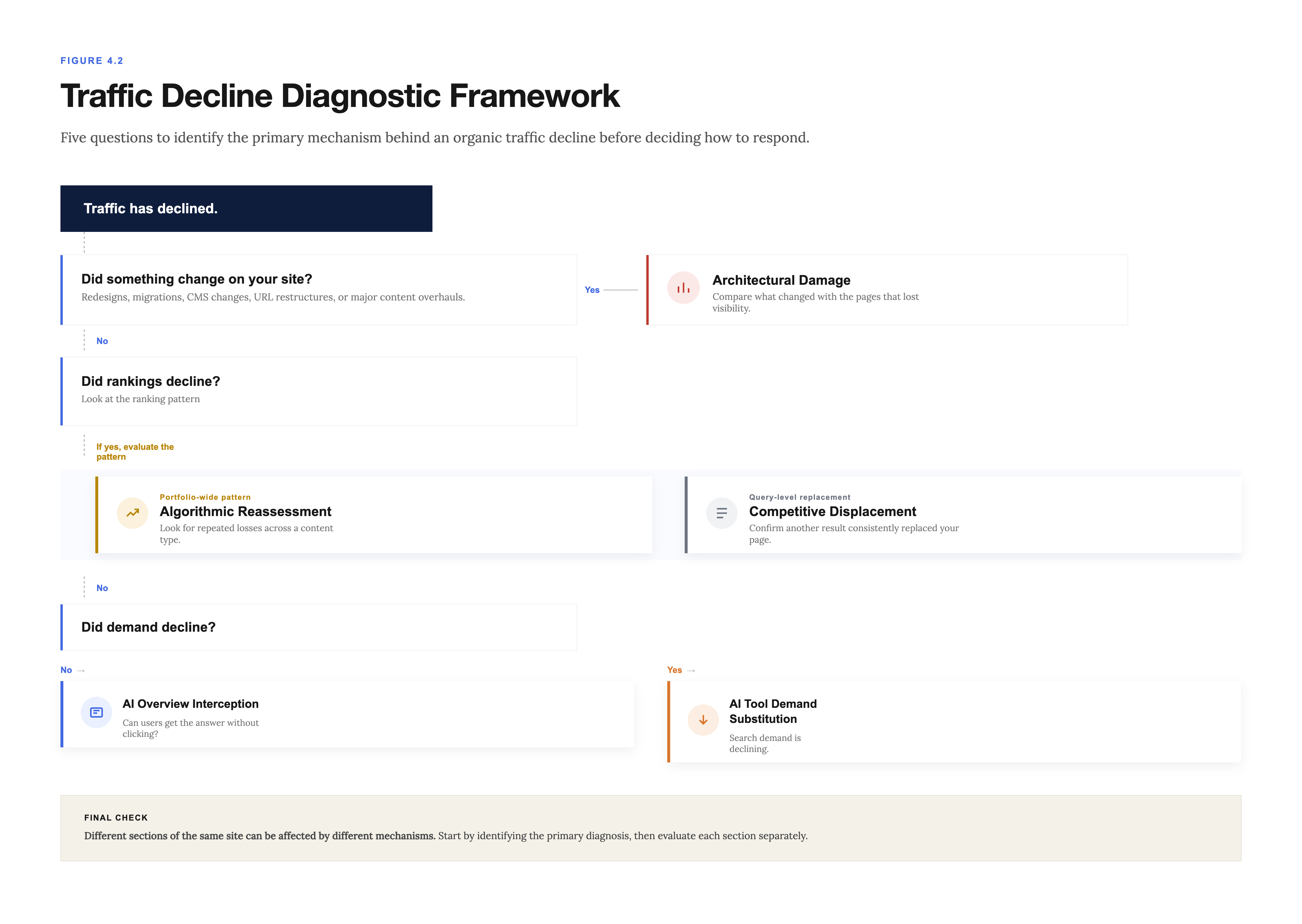
Step 1. Did something change on your own site?
If the decline began shortly after a redesign, migration, CMS change, URL restructure, or major content overhaul, start by investigating Architectural Damage.
The timing alone doesn’t prove the diagnosis. The affected pages and signals should also correspond to what changed.
If not, continue.
Step 2. Did rankings actually fall?
If rankings declined materially, ask what kind of decline occurred.
- Were losses concentrated within a particular content type or page model while other sections remained stable? → investigate Algorithmic Reassessment.
- Did specific competitors or result types consistently replace your pages on the same queries? → investigate Competitive Displacement.
If rankings mostly held steady, continue.
Step 3. Did demand change?
If rankings held but traffic declined, ranking loss probably isn’t the primary explanation.
Now ask whether people are still making the same searches.
- If impressions and search demand remained stable, inspect today’s SERPs. The pattern may be consistent with AI Overview Interception.
- If impressions or search demand declined, investigate AI Tool Demand Substitution.
Final check
Even after you’ve identified the primary mechanism, check demand across the affected query set.
Declining search demand can contribute alongside another mechanism. A single site can experience more than one mechanism across different groups of pages.
The Five Organic Traffic Decline Mechanisms at a Glance
Before diving into each mechanism individually, here’s the taxonomy at a glance.
| Mechanism | Primary signature | Evidence required | Common wrong treatment |
|---|---|---|---|
| Architectural Damage | Decline corresponds to a known internal change | Section-level impact tied to what changed; no stronger external explanation | Publishing around the break |
| Algorithmic Reassessment | Systematic loss concentrated by content model; unaffected page types behave differently | Portfolio-level pattern; alternatives weighed against | Rewriting or deleting unaffected content |
| AIO Interception | Estimated rankings hold while estimated traffic falls and demand remains stable | Stable demand plus changed SERP conditions on affected queries | Making already-satisfiable answers longer |
| AI Tool Demand Substitution | Impressions or search volume decline across affected query set | 12–18 month demand trend on affected queries | Producing more of the abandoned content format |
| Competitive Displacement | Specific results repeatedly replace yours on identifiable queries | Query-level replacement evidence | Sitewide technical work |
The mechanisms below follow the same order as the decision tree. Each section explains the diagnostic signature, the supporting evidence, and the most common recovery mistake.
Architectural Damage: Start With What Changed Internally
If your traffic decline began shortly after a redesign, migration, CMS change, or major site overhaul, this is the first mechanism to investigate.
Timing alone isn’t enough to make the diagnosis. The pages that lost visibility should also line up with what changed. If a redesign affected your product documentation, for example, that’s where you’d expect to see the losses — not across unrelated sections of the site.
Architectural damage can appear as an immediate cliff after a launch, or it can unfold over several weeks as Google recrawls and reprocesses the affected pages.
Freshworks is the clearest example from the cohort. In December 2025, the company launched its “Dew” design system. Soon afterward, 18,656 of the 30,000 keywords we sampled disappeared from the rankings entirely. During the same period, referring domains actually increased by 30.3%, suggesting the site wasn’t losing authority — it was losing visibility.
We can’t say exactly which technical change caused the decline. What we can say is that the redesign happened first, the ranking losses followed, and the pattern matches what we’d expect from an architectural problem affecting existing pages.
Wrong treatment: Publishing new content won’t repair pages that were damaged by the redesign. Until the underlying issue is fixed, new articles may perform normally while the affected pages continue to lose visibility.
Algorithmic Reassessment: Look for Portfolio-Level Ranking Loss
Algorithmic Reassessment happens when Google begins treating one category of content differently from the rest of your site. Instead of seeing isolated ranking losses on individual pages, you see the same pattern repeated across a group of similar pages while other sections continue performing normally.
This doesn’t have to coincide with a confirmed Google update. If it does, that strengthens the diagnosis. But the important signal is the pattern itself, not the calendar.
CloudBees and Ramp illustrate the clearest example. Around Google’s August 2025 spam update, both companies lost visibility across positions 11–20, 21–50, and 51+, while many of their strongest rankings held steady or even improved. In other words, Google didn’t stop trusting the entire site. It reassessed one class of content more harshly than another.
That’s what separates Algorithmic Reassessment from the other mechanisms:
- Architectural Damage begins with something your team changed.
- Competitive Displacement happens page by page, when another result consistently replaces yours for the same query.
- Algorithmic Reassessment appears as the same ranking pattern repeating across a larger group of similar pages.
Wrong treatment: Rewriting or deleting large amounts of content without understanding which pages were actually reassessed often makes the problem worse. Focus on the affected content type first, not the entire site.
AI Overview Interception: Rankings Hold, but Traffic Falls
AI Overview Interception happens when your rankings stay the same, but fewer people click because the search results answer the question before they ever reach your site.
Aha! is the clearest example from the cohort. The company held or improved estimated rankings across more than 20 queries while estimated traffic to those same pages fell between 80% and 99%.
Current SERP data from July 2026 shows AI Overviews on those same queries. That doesn’t prove AI Overviews caused the historical decline, but it does show those searches can now be satisfied directly in the SERP. Taken together, the evidence is consistent with AI Overview Interception.
To confirm this mechanism on your own site, ask a simple question: can someone get what they need without clicking?
Definitions, templates, checklists, short how-to guides, and other content that can be summarized directly in the search results are the most exposed. Content that requires comparison, judgment, calculation, or application is generally more resistant — AI can’t compress that kind of answer into a few paragraphs.
This is also what separates AI Overview Interception from Competitive Displacement. Under Competitive Displacement, rankings and traffic usually fall together because someone else replaced you. Under AI Overview Interception, rankings can remain stable while traffic declines because fewer people need to click the result in the first place.
Wrong treatment: Making an already-satisfiable page even more comprehensive may increase its chances of appearing in an AI Overview, but it doesn’t create a stronger reason for someone to click through.
AI Tool Demand Substitution: The Search Stops Happening
AI Tool Demand Substitution happens when people stop searching because AI tools can complete the task directly. The loss happens before Google is ever involved. If someone asks ChatGPT to generate a meeting agenda or a creative brief, they never perform the search that used to bring them to your site.
The key diagnostic signal is declining demand, not declining rankings. If impressions or search volume fall steadily across a group of related queries over 12–18 months, people may be changing how they solve that problem. There are simply fewer searches happening.
The difference between this mechanism and AI Overview Interception is where the traffic disappears:
| Signal | AIO Interception | AI Tool Demand Substitution |
|---|---|---|
| Impressions | Stable or growing | Declining |
| Rankings | Hold or improve | Not the primary signal; may remain stable |
| Estimated traffic | Falls because fewer people click | Falls because fewer people search |
| Where the loss happens | In the search results | Before the search ever happens |
Aha!‘s template library is a strong candidate for this mechanism. Its template pages declined 60.3% overall, with creative brief templates down 96.4%, strategy templates down 89.8%, and competitor analysis templates down 88.1%. Those are exactly the kinds of tasks general-purpose AI tools can now complete in seconds.
The content type alone is not enough to confirm Demand Substitution. To make that diagnosis, you also need evidence that search demand for those topics declined during the same period. Without that demand data, the content pattern is suggestive, but not conclusive.
We saw a similar pattern in another company’s developer tutorials as AI coding assistants became more capable. Again, the pattern is consistent with Demand Substitution, but without first-party impression or demand data it remains supporting evidence rather than definitive proof.
The broader lesson is that content performs better when people need more than a finished output. Pages that help readers compare options, apply judgment, or make decisions are harder for AI tools to replace than pages whose only purpose is to deliver an artifact like a template, script, or checklist.
Wrong treatment: Building more of a content format that people are no longer searching for does not restore demand. The problem isn’t that your pages became worse. It’s that fewer people need them in the first place.
Note: If AIO Interception or AI Tool Demand Substition is responsible for your decline, answer engine optimization (AEO) is your best path forward.
Competitive Displacement: Confirm Who Replaced You
Competitive Displacement happens when another result consistently takes the rankings you lost. That could be a direct competitor, a first-party source, a directory, or a different type of search result.
The important word is consistently. Seeing competitors rank after your traffic falls does not prove they caused the decline. Whenever a page loses visibility, something else has to fill the space. The replacement may be the result of another mechanism rather than the reason your page fell.
Secureframe shows why that distinction matters. Its traffic declined 35.2% while Vanta and Drata grew in the same Security and Compliance category. At first glance, that looks like a straightforward case of competitors taking market share.
But Secureframe’s ranking data showed a broader pattern. Positions 11–20, 21–50, and 51+ all collapsed around the same time in September and October 2025, following the August 2025 spam update. CloudBees and Sprinto showed a similar pattern. That evidence pointed more strongly to Algorithmic Reassessment than to a series of individual pages being outperformed by Vanta or Drata.
Those competitors may have gained some of the rankings Secureframe lost. But occupying a vacated position is not the same as causing the original loss.
To confirm Competitive Displacement, look at the affected queries individually:
- Which page previously ranked?
- Which result replaced it?
- Did that replacement rise during the same period your page fell?
- Does the pattern repeat across a meaningful group of related queries?
- Is there a clear reason the replacement better satisfies those searches?
If you cannot identify a repeatable query-level replacement pattern, you have not confirmed Competitive Displacement. A broad collapse across an entire content type usually points to a different mechanism.
Wrong treatment: Sitewide technical work will not recover rankings lost because another page better answers a specific query. First identify what replaced you and why. Then improve the pages where the competitive gap is actually visible.
When Multiple Mechanisms Affect the Same Domain
One of the biggest mistakes teams make is assuming a site has a single cause of decline. In practice, different sections of the same site can be affected by different mechanisms at the same time.
Aha! illustrates this well. Its informational content (role definitions, lists, and other answer-style pages) matched the AI Overview Interception pattern: rankings held while traffic fell. Its template library showed a different pattern, with evidence consistent with AI Tool Demand Substitution as demand for those searches declined.
That distinction matters because the two mechanisms require different responses. AI Overview Interception asks: can someone get the answer without clicking? AI Tool Demand Substitution asks: are people still searching for this at all? Treating both as simply “AI stole our traffic” hides the real problem and often leads to the wrong recovery strategy.
Start by identifying the mechanism responsible for the largest share of the decline. Then evaluate the rest of your site separately. A single domain can contain multiple diagnoses and each deserves its own treatment.
Don’t Treat the Symptom
An organic traffic drop tells you that something changed. It does not tell you what changed.
Too many recovery plans begin with a solution instead of a diagnosis. Teams publish more content, rewrite old pages, blame competitors, or overhaul their SEO strategy before they’ve identified the mechanism that actually caused the decline.
Resist that instinct.
Start with the data. Review your traffic trend, ranking patterns, internal changes, algorithm timing, and demand data. Use the framework to identify the mechanism first. Then choose a response that matches the problem you’re actually trying to solve.
The wrong treatment can consume months of work without addressing the real cause of the decline. The right diagnosis makes every subsequent decision more effective.
The full cohort findings are in our 18-month B2B organic traffic study. If you’ve identified the mechanism affecting your site and want a deeper recovery framework, The 2026 Modern Organic Growth Playbook expands on each mechanism, outlines recovery strategies, and introduces the Durable Demand Framework for building organic growth that’s more resilient to future shifts in search. If AIO Interception or Demand Substitution is your primary diagnosis, our answer engine optimization practice covers how to stay visible as AI systems increasingly answer queries directly.